Every autumn, your middle schooler or high schooler walks out the door on the first day of school looking like they packed for a month-long trip. Two textbooks, a Chromebook, a water bottle, a lunchbox, gym sneakers. The backpack is stuffed, the straps are pulling, and they’re already leaning forward before they hit the sidewalk.
Most Bayonne parents give it a passing thought and move on. Nobody handed you a guide at birth or kindergarten. Nobody mentioned that a heavy bag and poor ergonomics could be quietly changing the shape of your child’s developing spine.
This post is that guide.
What’s Actually Happening to Your Child’s Spine
A backpack doesn’t have to cause dramatic pain to cause real damage. The problem is what happens gradually when a growing spine carries more stress than it can adapt to.
If you tied a rope to the top of a young, flexible tree and pulled it backward every day for nine months, the tree would start to grow in that direction, right? A child’s spine responds the same way to frequent, unbalanced load.
Three things happen most often:
- The neck compensates for the weight pulling backward by pushing the head forward, a pattern called forward head posture. Other behaviors like looking down at screens and poor sitting posture also make this worse. For every inch the head moves forward of the shoulders, the effective weight on the cervical spine roughly doubles.
- When a student slings the bag over one shoulder, as most of them do, the spine begins to curve laterally to compensate. This creates an uneven load on muscles and vertebrae that are still developing.
- The compression on the thoracic and lumbar spine from carrying excessive weight day after day accumulates in ways that don’t always show up as pain right away. By the time a teenager complains, the pattern has often been building for months.
The spine is most vulnerable during growth. Middle and high school years are exactly when these patterns set in and, without attention, carry forward into adulthood.
The Backpack Warning Signs Most Parents Miss
As the school year gets underway, watch for these signs. None of them are a diagnosis on their own, but rather patterns worth paying attention to.
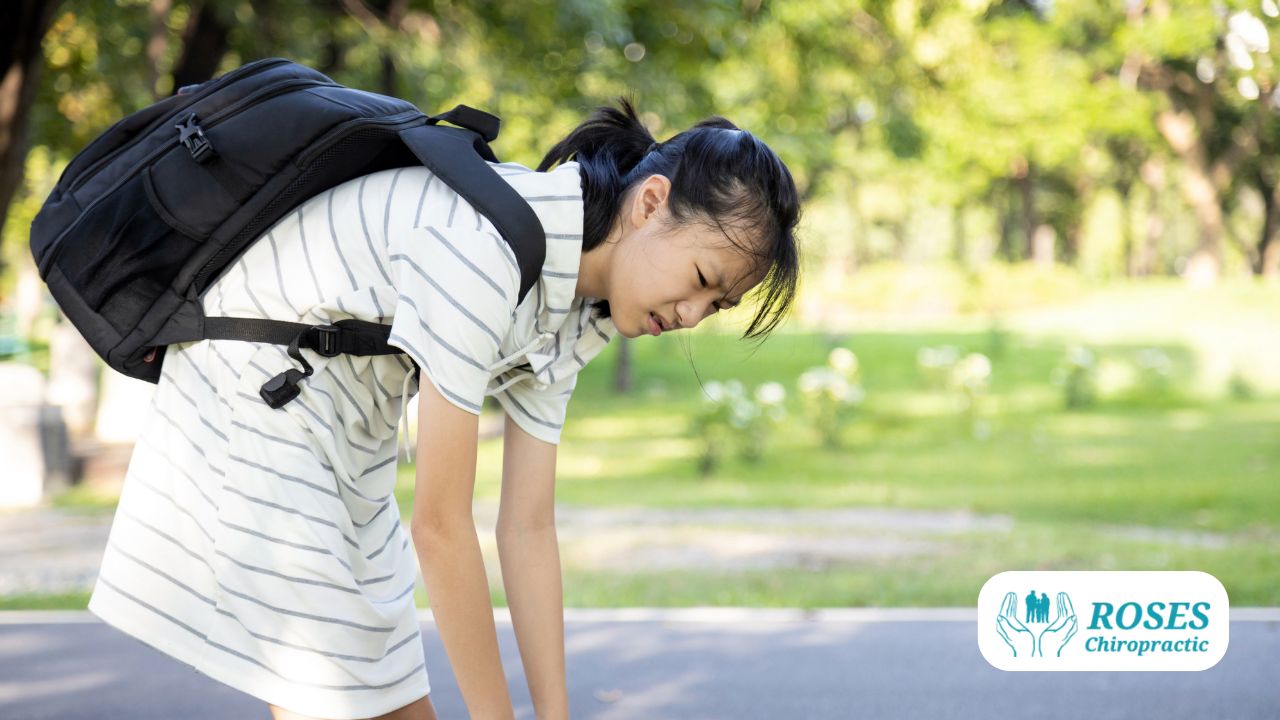
- Does your child complain of neck, shoulder, or upper back pain after school but feels noticeably better over the weekend?
- Do they consistently lean forward when walking, especially when wearing the backpack? Check if their head is ahead of their shoulders rather than stacked over them.
- Does one shoulder sit visibly lower than the other?
- Do they get headaches that tend to show up in the afternoon, after a full day of carrying and sitting?
- Does your child avoid putting the backpack on both shoulders? One-shoulder carrying may feel more natural to them because their body has already started to compensate.
- Does your child slouch more, round their upper back more, or hold their head further forward than they used to?
- They may mention that their back or neck “always” hurts, in the way kids normalize something they’ve been living with long enough that it just feels like background noise.
If any of these sound familiar, keep reading.
The Backpack Weight Rule, and Why Most Kids Are Way Over It
The American Academy of Pediatrics recommends that a child’s backpack weigh no more than 10 to 15 percent of their body weight.
For example, a 100-pound seventh grader should carry no more than 10 to 15 pounds. A 130-pound high school sophomore should carry no more than 13 to 19 pounds.
Now walk through what a typical Hudson County student carries on a regular school day: one or two hardcover textbooks, a Chromebook or laptop, a full water bottle, a lunchbox or snack, a binder or two, gym clothes on PE days. In many cases, that load is sitting between 20 and 30 pounds before they leave the house.
Here’s the fastest way to find out where your child stands: put their fully packed school bag on a bathroom scale right now. Many parents who do this for the first time are genuinely surprised by the number.
Practical Backpack Fixes Bayonne Families Can Make Today
The good news is that middle school and high school habits are fixable, and small changes make a meaningful difference.
- Always use both shoulder straps and tighten them so the bag sits close to the body rather than hanging low off the shoulders.
- The bottom of the backpack should rest at the waist, not below the hips. If it’s hanging down toward the lower back or the base of the spine, shorten the straps.
- Use the chest strap and waist strap if the bag has them. Most students never clip them, but clipping both distributes the load significantly better across the torso.
- Pack the heaviest items closest to the child’s back. The closer the weight is to the spine, the less leverage it has to pull the body backward.
- Use the locker. Many middle and high school students in Hudson County carry everything all day rather than stopping between classes. If a locker is available, use it. Remind your child to carry only what’s needed for the next two or three periods.
- On the heaviest load days, a rolling backpack is not embarrassing. Frame it as the smart choice.
- Consider pediatric chiropractic care to help support an adaptable nervous system and spine with proper movement.
What Dr. Roses Actually Looks At During a Pediatric Chiropractic Visit
If the warning signs above sound familiar, or if you want to support your child’s spine before problems develop, a spinal screening at Roses Chiropractic gives you a clear, objective picture.
An evaluation covers:
Posture assessment. Dr. Roses looks at how your child holds themselves from the front, side, and back. Forward head posture, elevated or dropped shoulders, and hip imbalance are all visible in posture and often the first place backpack strain shows up.
Titron scan. This is quick gentle scan identifies areas where nerve function is being compromised, often before those areas are painful. For a parent, the scan results are a great visual readout of what is actually happening in your child’s spine.
We use a gentle Titron scan to assess spinal alignment and nerve function, giving us clear, objective insights to guide safe and effective care for every member of your family.
Range of motion. Dr. Roses checks for proper movement in the neck and back move. Restrictions in range of motion, especially in a teenager, often point to areas of the spine that are carrying more stress than they should.
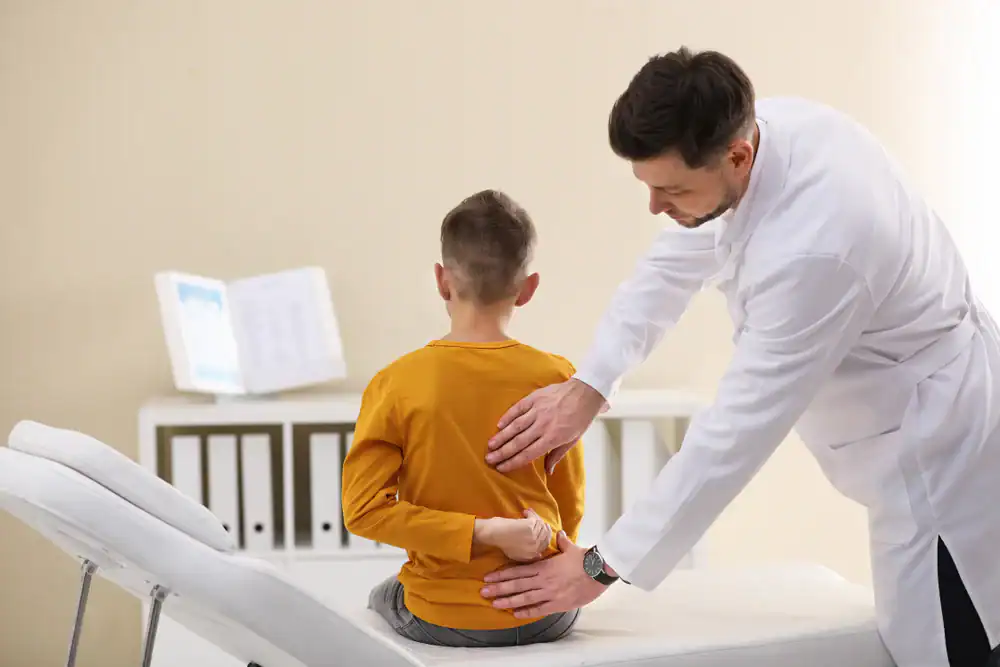
Spinal palpation. He feels along the spine for areas of tension, restricted movement, or vertebral misalignment. In students who have been carrying heavy bags for months, these areas are often found in the upper thoracic spine and the base of the neck.
A conversation. This part matters as much as the physical evaluation. Dr. Roses makes sure that you understand the findings of the evaluation and a care plan going forward. You and your child leave with a clear picture of how pediatric chiropractic could help you. There is no pressure and no long treatment plan pushed at a first visit.
A Note for the Parent Who Isn’t Sure About Pediatric Chiropractic
If your instinct is that chiropractic care is for adults with back injuries, not teenagers with sore shoulders, that’s a fair starting point. Most parents come in with that assumption.
Pediatric and adolescent chiropractic care looks very different from adult care. The adjustments are adapted to your child’s size, their stage of development, and their specific presentation. Nothing about the visit is aggressive or uncomfortable. Many teenagers walk out of their first visit surprised by how straightforward it was.
Dr. Roses has been caring for Bayonne children and teenagers for over 40 years. The practice is built around families. A spinal screening is a conversation and an evaluation to give you information you didn’t have before.
Why Bayonne NJ Parents Trust Dr. Roses
Dr. Paul Roses has been serving Hudson County families from his Bayonne NJ practice since 1982. Pediatric and family chiropractic care are the foundation of what this practice was built to do: to improve the health of the community.
The office accepts most insurance plans, including Medicaid and Medicare, so cost is not a reason to wait. Same-day appointments are often available. Dr. Roses even calls personally after every first visit to check in. The office serves both English- and Italian-speaking families.
Parents who have been bringing their children here for years describe the same experience: Dr. Roses listens, explains clearly, and tells you the truth about what he is seeing. We provide clarity for parents trying to sort out whether their teenager’s back pain is serious or just growing pains.
Ready to Find Out Where Your Child’s Spine Stands?
If anything in this post sounds familiar, the school year is already underway and the load on your child’s spine is not getting lighter on its own.
Call Roses Chiropractic at 201-339-2225 or text 973-313-7577 to schedule a spinal screening for your child. Same-day appointments are often available.
Thanks for sharing this article with the parents in your school group, your neighborhood chat, or your Bayonne community page. This is exactly the kind of information that gets skipped at orientation but matters all year long.
Learn more about other topics here.
Roses Chiropractic 901-899 Avenue C (corner of 41st Street, side entrance) Bayonne, NJ 07002