
Hear from Our Customers
You stop waking up with neck stiffness. Your headaches become less frequent, then rare, then gone. You sit through meetings without that burning sensation between your shoulder blades.
The tension you’ve been carrying for months starts to release because your spine isn’t fighting gravity anymore. When your head sits where it’s supposed to—directly over your shoulders instead of three inches forward—your muscles can finally relax. That’s not motivational talk. That’s basic physics.
Most people dealing with text neck symptoms in St. Pete, NJ don’t realize their head position is putting 60 pounds of pressure on their cervical spine. Every inch forward adds another 10 pounds. Your body compensates by tightening muscles that weren’t meant to hold that load, which is why you feel it in your neck, your shoulders, your upper back, and sometimes down into your arms.
Posture correction in St. Pete, NJ fixes the mechanical problem. You get your range of motion back. You breathe deeper because your ribcage can expand properly. You have more energy because your body isn’t burning fuel just to keep you upright.
Dr. Paul Roses has been practicing in Bayonne since 1981. He’s seen the shift from desk jobs to remote work, from desktop computers to smartphones, and the postural damage that came with each change.
He grew up here. He came back here to practice. He’s treated three generations of families in Hudson County, including plenty of residents from St. Pete, NJ who commute to New York or work from home and deal with the same forward head posture and rounded shoulders everyone else is struggling with.
You’re not getting a corporate clinic with rotating doctors. You’re getting someone who’s been doing this for over three decades and knows exactly what chronic poor posture does to your spine when it’s left untreated.
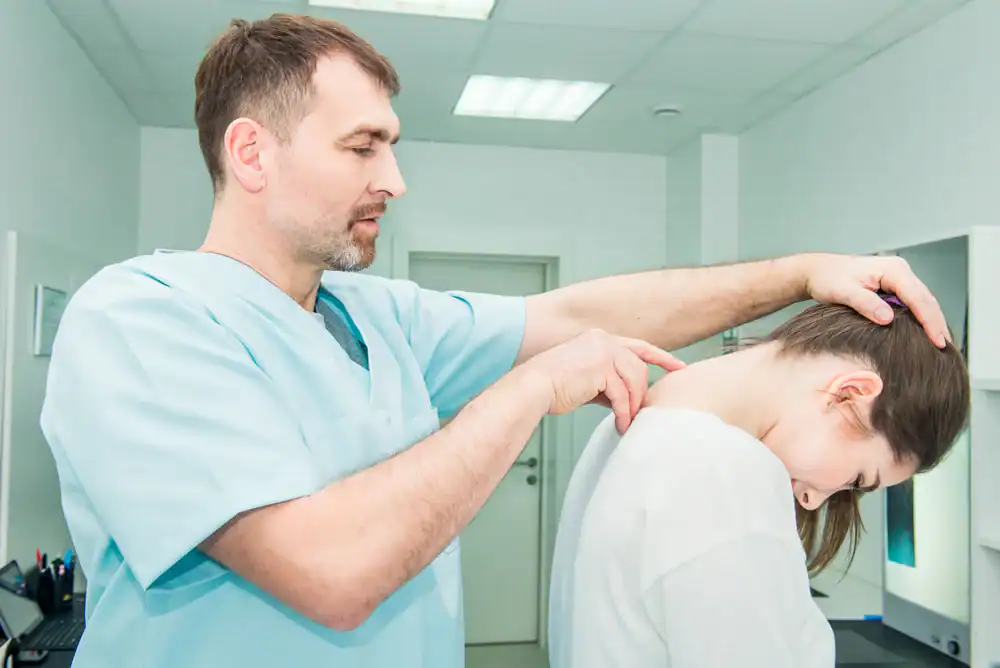
First, Dr. Roses does a postural assessment. He measures your head position, shoulder alignment, and spinal curvature to see exactly what’s happening. This isn’t guesswork—it’s specific angles and measurements that show how far off your alignment has drifted.
Then he identifies which muscles are overactive and which ones have shut off. Upper crossed syndrome in St. Pete, NJ patients typically shows up as tight chest and neck muscles with weak upper back and deep neck flexors. That imbalance is what’s holding you in that forward position.
Treatment starts with chiropractic adjustments to restore proper joint motion in your spine. When your vertebrae move correctly, your nervous system stops sending pain signals and your muscles can start rebalancing.
You’ll also get corrective exercises—specific stretches for the tight muscles and strengthening moves for the weak ones. These aren’t generic YouTube exercises. They’re based on your individual assessment and designed to retrain your posture so it holds between visits.
Most people notice less pain within the first few visits. Full correction of forward head posture in St. Pete, NJ typically takes several weeks to a few months, depending on how long you’ve had the problem and how severe it is.

Ready to get started?
You get a complete spinal and postural screening that measures the exact degree of your forward head posture, rounded shoulders, and any thoracic kyphosis. We use this baseline to track your progress throughout treatment.
Chiropractic adjustments target the specific vertebrae that have lost proper motion. For most St. Pete, NJ patients dealing with text neck and upper crossed syndrome, that means focused work on the cervical spine and upper thoracic region where the dysfunction is concentrated.
Corrective exercises are customized based on your assessment. If your upper traps and pec muscles are overactive while your lower traps and serratus anterior are weak—which is the classic pattern—you’ll get stretches and strengthening moves designed to reverse that imbalance.
You’ll also get lifestyle advice that actually applies to your situation. If you’re working from home in St. Pete, NJ without a proper desk setup, Dr. Roses will tell you exactly how to adjust your monitor height, keyboard position, and chair to stop recreating the problem every day. If you’re commuting and spending two hours on your phone, you’ll learn how to hold it without destroying your neck.
The goal isn’t just to feel better for a week. It’s to correct the underlying postural dysfunction so you’re not dealing with chronic neck pain, headaches, and shoulder tension for the rest of your life.

It depends on how long you’ve had it and how severe it is. If you’ve been dealing with forward head posture for a few months, you might see significant improvement in 6-8 weeks with consistent treatment and exercises. If it’s been years, expect 3-6 months for full correction.
The timeline also depends on whether you’re actively making it worse every day. If you’re still hunching over your phone for hours or working at a poorly set-up desk, progress will be slower. Dr. Roses will give you a realistic timeline after your initial assessment based on your specific measurements and lifestyle factors.
Most St. Pete, NJ patients notice less pain and better range of motion within the first few visits. Full structural correction—where your head position is back where it should be and stays there—takes longer because you’re retraining muscles and ligaments that have been holding you in the wrong position for months or years.
Text neck shows up as pain and stiffness in your neck, especially at the base of your skull. You might get headaches that start in your neck and move forward. Your shoulders feel tight and knotted. Sometimes you’ll feel pain or tingling down into your arms.
The underlying problem is that tilting your head forward to look at your phone puts massive stress on your cervical spine. At a 60-degree angle—which is normal when you’re texting—that’s 60 pounds of force on your neck. Your muscles tighten up trying to support that load, which is why you feel it in your upper traps, levator scapulae, and suboccipital muscles.
Treatment for text neck in St. Pete, NJ involves chiropractic adjustments to restore motion in your cervical vertebrae, soft tissue work to release those chronically tight muscles, and exercises to strengthen the deep neck flexors that should be supporting your head. You’ll also need to change how you use your phone—bring it up to eye level instead of dropping your head down to it.
Yes. Rounded shoulders are almost always a muscular imbalance problem, not a structural defect that requires surgery. Your chest muscles and front deltoids are tight and overactive. Your mid-back muscles and rear deltoids are weak and underactive. That pulls your shoulders forward.
Correction involves stretching the tight muscles—specifically your pecs, anterior delts, and upper traps—and strengthening the weak ones like your rhomboids, lower traps, and rotator cuff muscles. Chiropractic adjustments help restore proper motion in your thoracic spine and shoulder joints so those muscles can rebalance.
For St. Pete, NJ patients with rounded shoulders from desk work or phone use, we also address your workspace setup and daily habits. If you’re recreating the problem eight hours a day, exercises alone won’t fix it. You need both the corrective treatment and the environmental changes to get lasting results.
Upper crossed syndrome is a specific pattern of muscle imbalance where your upper traps and pecs are tight while your deep neck flexors and lower traps are weak. It creates a characteristic posture: forward head position, rounded shoulders, and increased curve in your upper back.
It’s called “crossed” because if you draw lines connecting the tight muscles and another set of lines connecting the weak muscles, they form an X across your upper body. This pattern is extremely common in people who sit at computers or look down at phones for extended periods.
Treatment in St. Pete, NJ focuses on breaking that pattern. Dr. Roses uses chiropractic adjustments to restore proper joint function in your cervical and thoracic spine. You’ll get specific stretches for your tight pecs, upper traps, and levator scapulae. You’ll also get strengthening exercises for your deep neck flexors, rhomboids, and lower traps to rebuild the muscles that should be supporting good posture. The goal is to reverse the imbalance so your body naturally holds itself in proper alignment instead of constantly pulling forward.
Many insurance plans cover chiropractic care, including treatment for postural problems that are causing pain and dysfunction. Coverage varies depending on your specific plan, your deductible, and whether you need a referral.
We can verify your insurance benefits before you start treatment so you know exactly what’s covered. Some plans cover a certain number of visits per year. Others cover treatment for specific conditions like neck pain or headaches that result from poor posture.
If you don’t have insurance or your plan doesn’t cover chiropractic care, we offer affordable self-pay options for St. Pete, NJ patients. The cost of a few months of posture correction treatment is significantly less than years of pain medication, multiple specialist visits, or eventual surgery if the problem progresses to degenerative disc disease.
You keep doing the exercises. The stretches and strengthening moves you learned during treatment aren’t just for fixing the problem—they’re for maintaining the correction. Most people need to do them 3-4 times per week long-term to keep their muscles balanced.
You also need to set up your environment correctly. If you work at a desk, your monitor should be at eye level, your keyboard at elbow height, and your chair supporting your lower back. If you’re on your phone frequently, hold it up instead of dropping your head down. These aren’t optional if you want to avoid sliding back into forward head posture.
We recommend periodic check-ups even after your posture is corrected—usually every 4-6 weeks for St. Pete, NJ patients with desk jobs or high phone use. These maintenance visits catch small problems before they become big ones and keep your spine moving properly. Think of it like getting your car aligned. You don’t wait until your tires are bald to do it.